
Benefits of Offering Environmental Science in Your Victorian Secondary School
Environmental Science gives Victorian students a rigorous, interdisciplinary and highly relevant science education — one that connects directly to real-world environmental challenges and visible career pathways.
Drawing on the VCE study design, the subject offers breadth, hands-on learning and strong post-school opportunities.
A Future-Focused, Interdisciplinary Science
Environmental Science integrates Biology, Chemistry, Physics and Earth/Geosciences into one cohesive study, helping students understand how Earth’s systems — the atmosphere, biosphere, hydrosphere and lithosphere — interact to support life. Students explore sustainability, biodiversity, climate change and human impacts through curriculum-framing questions across Units 1–4, such as “How can climate change and the impacts of human energy use be managed?”
This breadth appeals to students who enjoy science but want a broader, systems-thinking approach rather than a single discipline.
Hands-On, Fieldwork-Rich Learning
Environmental Science is not a desk-bound subject. Every unit includes practical investigation and fieldwork — from water, soil and air quality testing to biodiversity surveys, climate modelling and conservation case studies. Students undertake genuine scientific investigations, building skills in data collection, analysis, risk assessment and evidence-based communication.
This experiential learning strengthens engagement and supports diverse learning styles.
Clear and Diverse Career Pathways
Environmental Science maps directly to some of Australia’s fastest-growing sectors, from entry-level roles through to professional careers, including:
Environmental Scientist, Environmental Engineer, Environmental Manager
Geologist, Geophysicist, Meteorologist
Park Ranger, Forester, GIS Technician, Landscape Architect
Agricultural Scientist/Engineer, Urban and Regional Planner
Environmental Lawyer
Environment Policy Adviser, Sustainability Officer , Environmental Community Educator
Chemist, Materials Scientist, Civil Engineer
These pathways span Certificate-level roles (Level 1) through to Bachelor-qualified professions (Level 4), ensuring students of all aspirations see a tangible future.
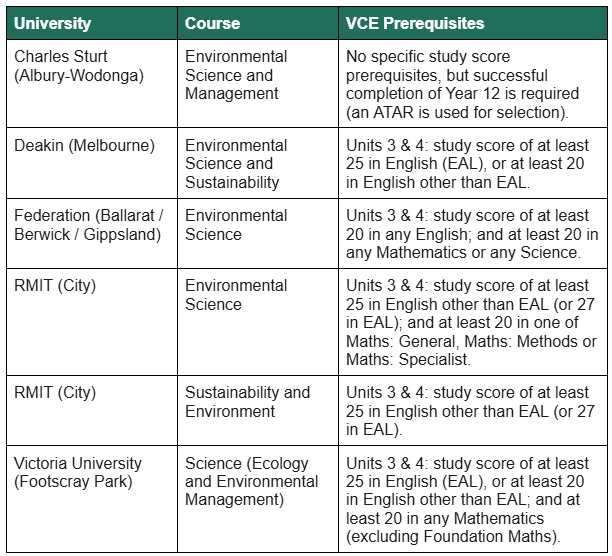
Many Victorian universities offer dedicated Environmental Science and Sustainability degrees, as well as majors within broader Science programs. Entry requirements typically include English and Mathematics or Science at Units 3–4.
Learn more about pathways from VCE to careers with this video https://www.eev.vic.edu.au/careers-in-sustainability-and-environment
Builds High-Value STEM Skills
Students develop transferable scientific skills essential for university and STEM careers:
Designing investigations and hypotheses
Collecting and analysing data
Applying safety and ethical guidelines
Evaluating accuracy, precision and error
Communicating scientific findings clearly and persuasively
These capabilities align strongly with employer expectations in environmental, scientific and technical fields.
Supports School Sustainability Goals
Environmental Science aligns naturally with Victoria’s environmental sustainability priorities. It helps schools embed authentic sustainability learning, supports student leadership in environmental initiatives, and strengthens whole-school approaches to climate, biodiversity and resource management.
University Courses in Victoria
Environmental Science is commonly offered as a major within a broader Science degree — including at Monash University (Bachelor of Science) and the University of Melbourne (Bachelor of Science). Dedicated Environmental Science / Sustainability courses are also available at several Victorian universities:
Useful Links for Schools
EEV’s VCE Environmental Science Resources including revision exams and textbooks.
VCE Environmental Science Study Design (VCAA) https://www.vcaa.vic.edu.au
myfuture Environmental Sciences Career Bullseye https://www.myfuture.edu.au