EEV Lending Library
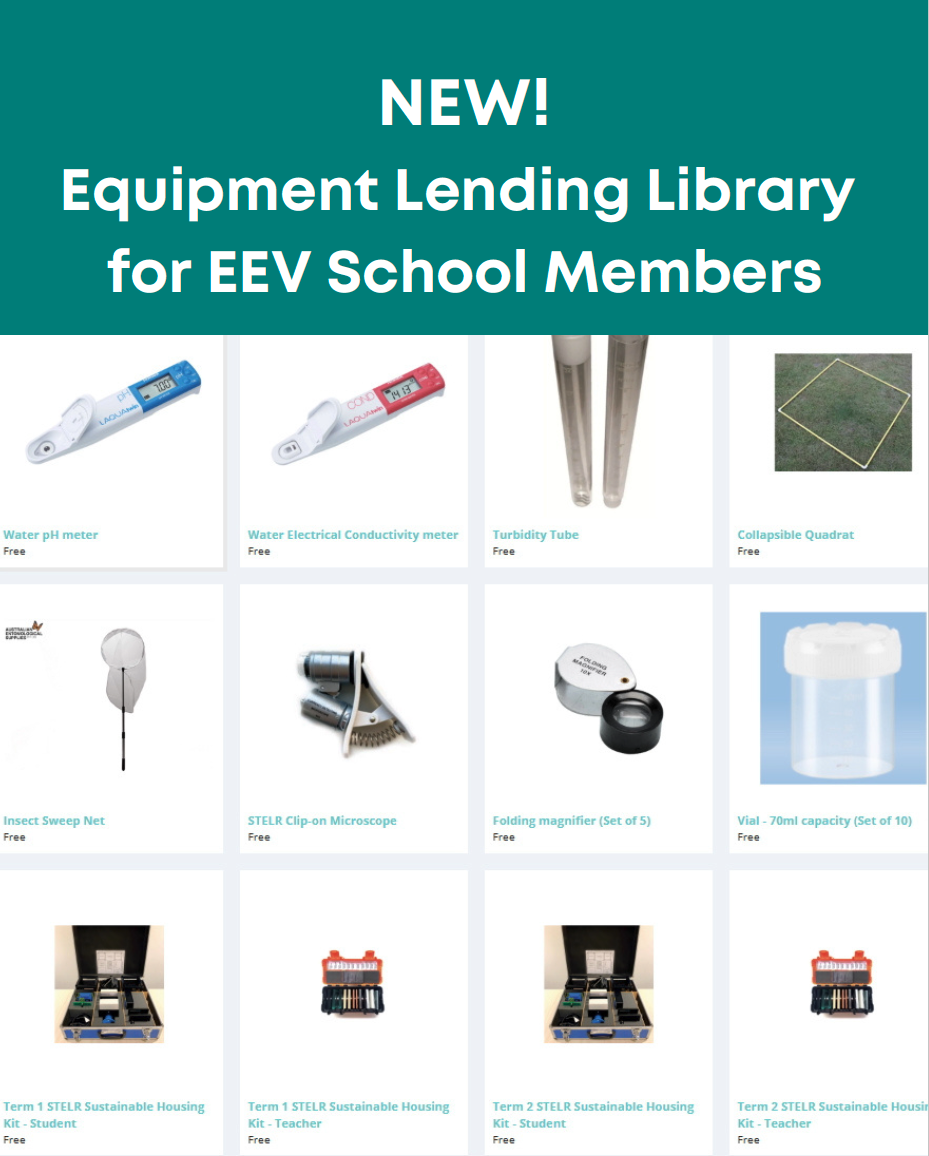
The EEV Lending Library is free for school members. Member schools can borrow items for a term at a time. It’s a great way to save money on expensive equipment that you might only use once a year, or to trial use before committing to a purchase, or to boost numbers for larger classes.
Items useful for water quality monitoring include:
LAQUA-Twin Waterproof pocket pH meter.
LAQUA-Twin Waterproof pocket EC meter.
Turbidity Tubes with Nephelometric turbidity units (NTUs) etched on the tube.

ResourceSmart Schools
is a free Victorian government program that supports Victorian schools to embed sustainability across the school facilities, community and curriculum, while saving resources and money for the school.
Schools join the program, then have access to an online portal (ResourceSmart Schools online), where they learn and practice ways to integrate sustainability.
EEV supports schools in the Western Metropolitan Region with free advice, onsite assistance and resources.
To find out more: Click here for Western Metro Schools
Click here for all other Victorian schools
Fish Tanks in Schools Program
Native Fish Australia (Vic) partners with schools, government agencies and grant programs to place fish tanks in schools. Participation in our Fish Tanks in Schools program can be self-funded by schools or through grants secured by the school or Native Fish Australia. This funding is used to cover the costs of the fish tank, equipment, some tank maintenance and educational sessions.
Extension Resources for VCE Environmental Science
Ocean, Weather and Climate, Australian Government
How does the ocean regulate our weather and climate?
How is climate change affecting the ocean?
How can the ocean and ocean industries help mitigate climate change?
includes a glossary
The Oceans and Atmosphere, Climate Change Australia
Effects of Climate Change on the global conveyor belt - increased rainfall can change salinity in local areas, and change currents.

How ocean currents shape our climate and future - Film
The Gulf Stream (ocean current) - brings warm water from the Gulf of Mexico (America on US govt websites) into the Atlantic Ocean. It runs up the east coast of the US.
The Humbolt Current (story telling format with beautiful images). also known as the Peru Current, is a cold, low-salinity ocean current that flows northward along the western coast of South America (Wikipedia)
Thermohaline Circulation, National Ocean Service, NOAA (USA)
winds drive ocean currents for the surface (upper 100 m)
currents thousands of metres below the surface are driven by differences in the water’s density
Density is controlled by temperature(thermo) and salinity (haline)
at the poles, the formation of ice increases salt concentration in surrounding water
increasing salinity increases density, and the water starts to fall creating a current